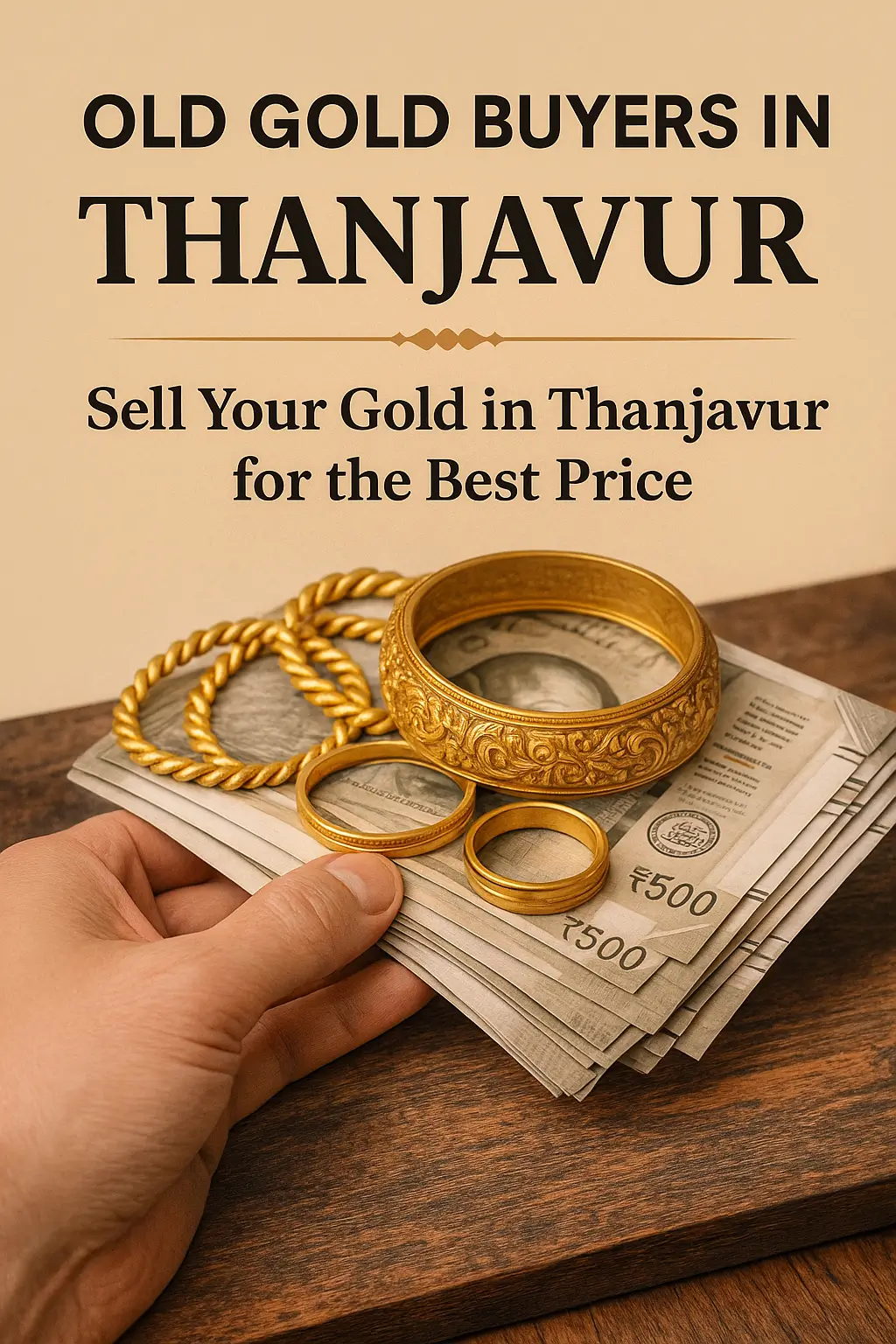
Old Gold Buyers in Thanjavur
Sell Your Gold in Thanjavur for the Best Price
Pledge Released gold sell – அடகு நகை மீட்டு அதிக விலைக்கு விற்க
Thanjavur households tend to hold older gold than most places in Tamil Nadu. Pieces that came down through three generations. Temple jewellery made for a dancer in the family. Heavy vanki and oddiyanam ordered from a goldsmith who died decades ago. Kemp sets worn once a year, if that.
That changes what an honest gold buyer owes you here. In most places the only question is purity and weight. In Thanjavur, there is a second question worth asking first: is this piece worth more as jewellery than as gold?
Sometimes it is. And when it is, we will tell you — even though it means we do not buy it.
Sell Your Gold at Best Price
Some Old Jewellery Should Not Be Sold for Melt Value
Almost every gold buyer, anywhere, values your ornaments one way: purity multiplied by weight. For the overwhelming majority of jewellery that is correct and fair, because the gold is genuinely the only thing of value.
But a small number of older pieces are different. Hand-crafted antique work, distinctive regional designs, jewellery made by a known goldsmith’s workshop, unusual temple pieces, and certain kemp and Nagapattinam-style sets can carry value to collectors, dealers and jewellery houses that exceeds the value of the metal in them. Melting such a piece destroys that difference permanently, and it cannot be undone afterwards.
We are gold buyers, not antique dealers. What we can do is look at what you bring and say honestly when a piece looks like it belongs in that category. If it does, our advice will be to get a second opinion from an antique jewellery specialist or an established jeweller before selling it to anyone for scrap — including us.
This costs us transactions. We do it anyway, because the alternative is quietly melting something irreplaceable that a family kept for a hundred years, and no rate on any board justifies that.
The practical rule: the older and more distinctive the workmanship, the more worthwhile a second opinion becomes. For ordinary modern jewellery, a broken chain, coins or scrap, melt value is the real value and there is nothing further to consider.
Temple Jewellery, Kemp Sets and Dance Ornaments
Thanjavur’s connection to Bharatanatyam means a lot of temple jewellery sits in cupboards across this district — full dance sets, jadai billai and jadai nagam for the plait, nethi chutti, vanki, oddiyanam belts, thodu and jhimki.
These need care in valuation because they are rarely solid gold throughout. A typical set combines gold with kemp stones, sometimes a lac or resin filling for body and shape, silver components, and occasionally a base-metal frame under gold work. The gold content can be a modest fraction of the total weight the set appears to have.
That is not a reason to be discouraged, and it is certainly not a reason to accept a low flat offer. It is a reason to insist that each component is assessed separately rather than the set being weighed as one lump and offered a single number. Any buyer who weighs a full dance set on the scale and quotes one figure without breaking it down is either not looking properly or is counting on you not asking.
We separate and assess each part, tell you what is gold and what is not, and quote only on the gold. And if the set is complete, well-made and still usable, we will say plainly that it may fetch considerably more sold intact to a dancer, a dance school or a costume house than it ever will melted down.
Is It Gold, or Is It Covering?
A great many families discover, sometimes uncomfortably, that a piece they believed was gold is covering — gold-plated or rolled-gold jewellery over a base metal. This is extremely common with older gifted items and with jewellery bought outside a known shop, and it says nothing about anyone’s honesty. It is simply how a lot of jewellery was made and sold.
A few things you can check at home before you visit:
Weight relative to size. Gold is very dense. A gold piece feels distinctly heavier in the palm than a covering piece of identical size. If you have one item you are certain about, compare the two by hand.
Worn edges and high points. Look closely at clasps, the inside of bangles, and any surface that rubs. Plating wears through first at these points, revealing a whitish, reddish or grey metal underneath.
Discolouration. Green or black marks on the skin, or dark patches on the piece itself, indicate base metal. Real gold does not tarnish and does not stain skin.
A magnet. Gold is not magnetic. If a magnet pulls at your piece, it contains a magnetic base metal. Note that the reverse is not proof — plenty of non-gold metals are also non-magnetic — so a piece that ignores a magnet still needs proper testing.
Hallmark stamps. Check clasps and the insides of bangles for 916, 750 or 999. Older jewellery frequently has no stamp at all, so an absent hallmark proves nothing either way.
None of this is conclusive. Machine testing settles it in seconds, it is free here whether you sell or not, and there is no embarrassment in the answer. We would far rather tell you the truth about a piece than have you carry a wrong belief about it for another twenty years.
Thanjavur art plates and gold-foil work come up often enough to mention. The gold used in Thanjavur painting and in art plate work is foil — its weight is negligible, and there is essentially no recoverable gold value in it. Those pieces are worth what they are worth as artwork, which is a matter for an art dealer rather than a gold buyer.
Releasing Gold Pledged With a Bank or Finance Company
If your ornaments are currently pledged against a loan, you do not have to find the money to redeem them yourself before selling. We can settle the outstanding amount directly with the lender and pay you the difference between that amount and your gold’s market value.
To get a clear figure, bring:
- Your pledge receipt or loan account document
- The current outstanding amount, including accrued interest, from the lender
- Your ID and, ideally, the account details for the balance payment
We will tell you the net figure before anything is set in motion, so there are no surprises at the end. If the outstanding loan has grown close to the value of the gold — which does happen when a loan has been renewed repeatedly over several years — we will say so directly rather than push the transaction through for the sake of completing it.
The release itself follows the lender’s own procedure and timeline, which varies between banks and finance companies. We will explain what applies in your case at the counter.
What Happens When You Visit
Your items are received and listed individually. Each one is tested for purity in front of you using a non-destructive machine — no cutting, no filing, no acid, no melting. Whatever you bring goes home in exactly the condition it arrived in unless you choose to sell it.
Each item is weighed on a calibrated scale positioned so you can read the display. Stones, lac filling, thread and non-gold components are identified and separated, so what you see is the actual gold weight rather than a gross figure.
You are then given the karat, the net weight and the value of each piece individually, never as one bundled total. This matters, because you may want to sell three items and keep four — and that is entirely your choice. There is no minimum, and no obligation to sell anything at all.
Payment for what you do sell is settled the same visit: cash for smaller amounts, or UPI, NEFT, IMPS or RTGS for larger ones, initiated while you are still here. Testing is free either way, and declining costs you nothing.
What We Buy in Thanjavur
- Old gold jewellery of every kind and age
- Broken, bent and damaged ornaments
- Unpaired earrings and incomplete sets
- Gold coins and biscuits, any make, with or without packing
- Gold bars
- Scrap gold
- Pledged and loan gold
- Antique and temple pieces, subject to the valuation advice above
- Stone-set jewellery, with gold assessed separately
- 24K, 22K, 20K and 18K items
- Silver jewellery, coins, plates and articles
No purchase bill is needed for any of it. Almost no inherited gold in Thanjavur comes with paperwork.
How Your Price Is Determined
Purity and net weight, applied against the market rate for that purity on the day you visit. Nothing is deducted afterwards — no melting charge, no wastage percentage, no testing fee, no handling.
Purity varies more in older jewellery than people expect. Most traditional Tamil Nadu work is 22 karat, stamped 916. But older regional and imported pieces sometimes test at around 20 karat, and lightweight or stone-set designs are frequently 18 karat. These differences are significant — the gap between 22K and 18K is roughly 18% of value — which is why every item is tested rather than assumed, and why a buyer quoting a price before testing is not quoting seriously.
What to Ask, and What Not to Accept
Worth asking anywhere, including here:
- Can each item be valued separately rather than as one total?
- What in this set is gold and what is not?
- Does this piece look like it could be worth more than its melt value?
- What is the net weight after stones and filling are excluded?
- Can I take this valuation away and think about it?
And two rules that hold regardless of who you are dealing with: your gold should never leave your sight during testing, and it should never be left overnight for a valuation. Testing takes minutes. There is no honest reason for either.
Documents You Need
A government-issued photo ID is mandatory for every gold sale under India’s KYC and income tax rules — Aadhaar or PAN, with PAN required for higher-value transactions. Passport, voter ID and driving licence are also accepted as photo ID.
Under Section 269ST of the Income Tax Act, no person may receive ₹2 lakh or more in cash from a single transaction, and that restriction applies to you as the recipient. Larger amounts are therefore paid by bank transfer, so bring your account details, and visit during banking hours if you expect a substantial payout.
On tax: capital gains may apply depending on how long the gold was held and its original cost, with inherited gold treated differently again. These rules have changed in recent budgets. For a routine household sale it is rarely significant, but for anything large, ask a chartered accountant rather than a gold buyer.
Serving Thanjavur and the Delta
Customers reach us easily from South Main Street, East Main Street, Gandhiji Road, Nanjikottai Road, Medical College Road, Karanthai, Vallam, Srinivasapuram and the Big Temple area.
We also serve people travelling in from Kumbakonam, Papanasam, Pattukottai, Thiruvaiyaru, Orathanadu, Peravurani, Ammapettai, Budalur, Swamimalai, Thiruvidaimarudur and Thiruppanandal, and from the neighbouring Tiruvarur, Nagapattinam, Pudukkottai and Trichy districts.
தஞ்சாவூரில் பழைய தங்கம் விற்க
பழைய, ஆண்டிக் மற்றும் கோயில் நகைகளுக்கு உருக்கு மதிப்பை விட அதிக மதிப்பு இருக்கலாம் — அப்படி இருந்தால் நாங்கள் அதை நேர்மையாகச் சொல்கிறோம். ஒவ்வொரு நகையும் தனித்தனியாக, உங்கள் முன்னிலையிலேயே சோதிக்கப்படும். கவரிங்கா அல்லது உண்மையான தங்கமா என்பதை இலவசமாக உறுதி செய்யலாம். அடகு வைத்த நகைகளையும் மீட்டுத் தர உதவுகிறோம். உருக்கு கட்டணம் இல்லை, கழிவு இல்லை. உடனடி பணம் அல்லது வங்கிப் பரிமாற்றம்.
Bring It In and Find Out
The valuation is free, it takes about fifteen minutes, and you are under no obligation at the end of it. If you simply want to know whether an old piece is gold at all, or whether it deserves a specialist’s eye before anyone melts it, that is a perfectly good reason to walk in.
FAQs
1. Where can I sell old gold in Thanjavur?
Yellow Gold Point is a trusted old gold buyer serving Thanjavur and surrounding areas. We offer free purity testing, current market rate, and instant cash with no hidden deductions.
2. Do old gold buyers in Thanjavur charge melting or wastage fees?
No. Reputable old gold buyers do not charge melting or wastage fees when buying your gold. Yellow Gold Point applies zero wastage deductions — you receive the full value of your pure gold weight at today’s market rate.
3. How quickly can I get cash for my gold in Thanjavur?
The entire process from walk-in to payment takes 20 to 30 minutes. This includes purity testing, weight measurement, price offer, and instant cash or bank transfer payment.
4. Can I sell broken or pledged gold in Thanjavur?
Yes. Yellow Gold Point buys all forms of old gold — broken jewellery, coins, bars, and pledged gold. Condition and design do not affect the gold’s value. Only purity and weight determine the rate.
5.Can I sell gold coins or biscuits?
Yes. 22K and 24K gold coins/bars are accepted and usually fetch higher value.
6. Is the process safe?
Yes, trusted gold buyers have CCTV, transparent testing, and secure procedures.
7. My jewellery is very old. Should I just sell it for gold value?
Not necessarily. Distinctive antique or hand-crafted work occasionally carries value beyond its metal content. Bring it in — if it looks like one of those pieces, we will tell you and suggest a specialist opinion before anyone melts it.
8. How do I know if my jewellery is real gold or covering?
Weight, worn edges showing base metal underneath, skin discolouration and a magnet give you rough indications at home. None is conclusive. Machine testing settles it in seconds and is free here whether or not you sell.
9. Do you buy temple jewellery and dance sets?
Yes, though these are usually part gold and part stones, lac or silver. We assess each component separately and quote only on the gold — and if the set is complete and usable, we will tell you when selling it intact would likely serve you better.
10. What about Thanjavur art plates and gold-foil work?
The gold in foil work is negligible in weight and has essentially no scrap value. Those items are worth what they are worth as artwork, which is a matter for an art dealer.